
What We Feed the Miles
Running is What We Eat

What We Feed the Miles
Runners are a strange breed.
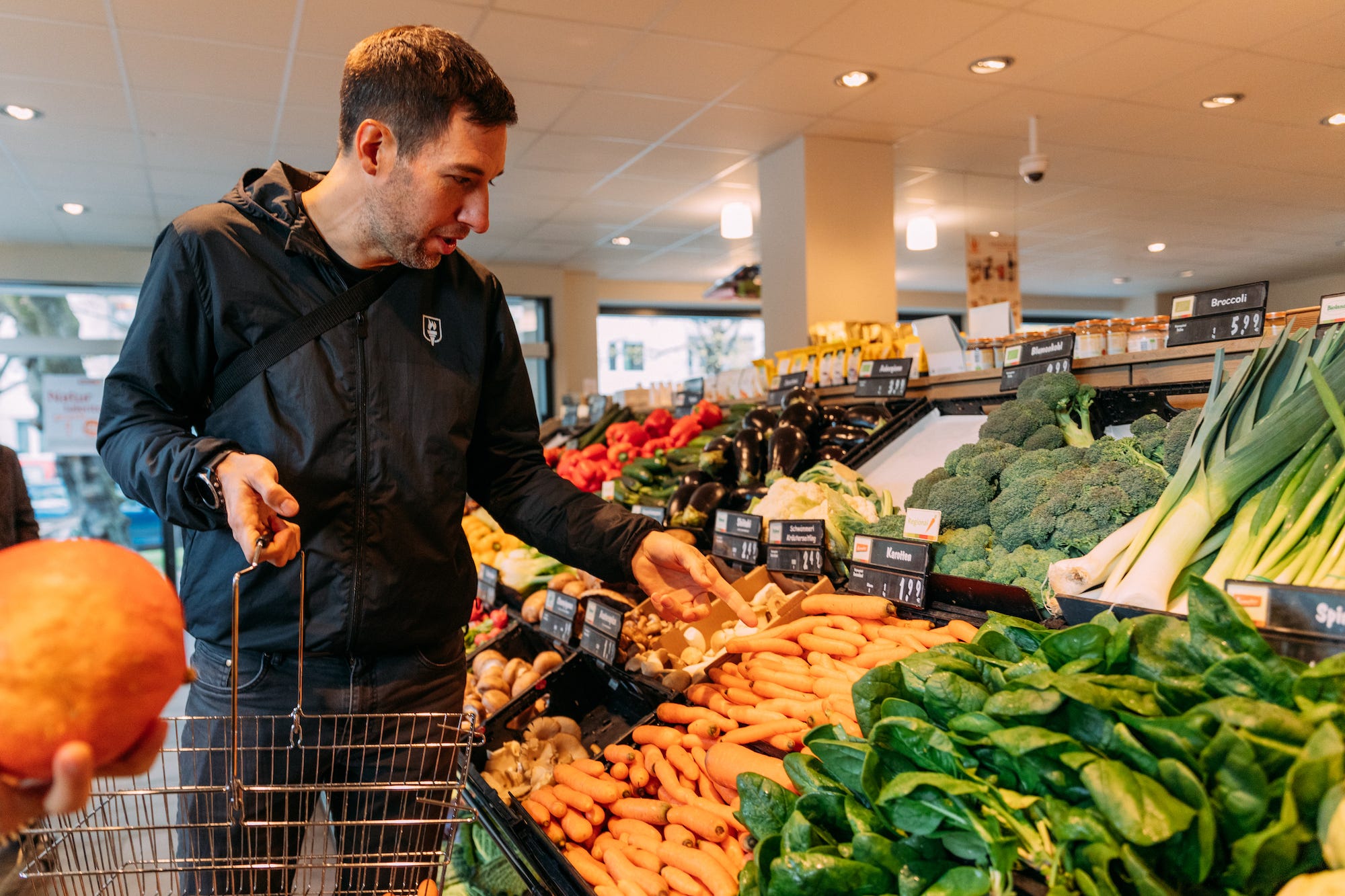
We brag about clean eating, load our plates with vegetables, track our macros, pop our supplements. We say stuff like “Shit in – Shit out” – the idea that what you put into your body is exactly what you get out of it. Sensible. Rational. Healthy.
And then comes race day.
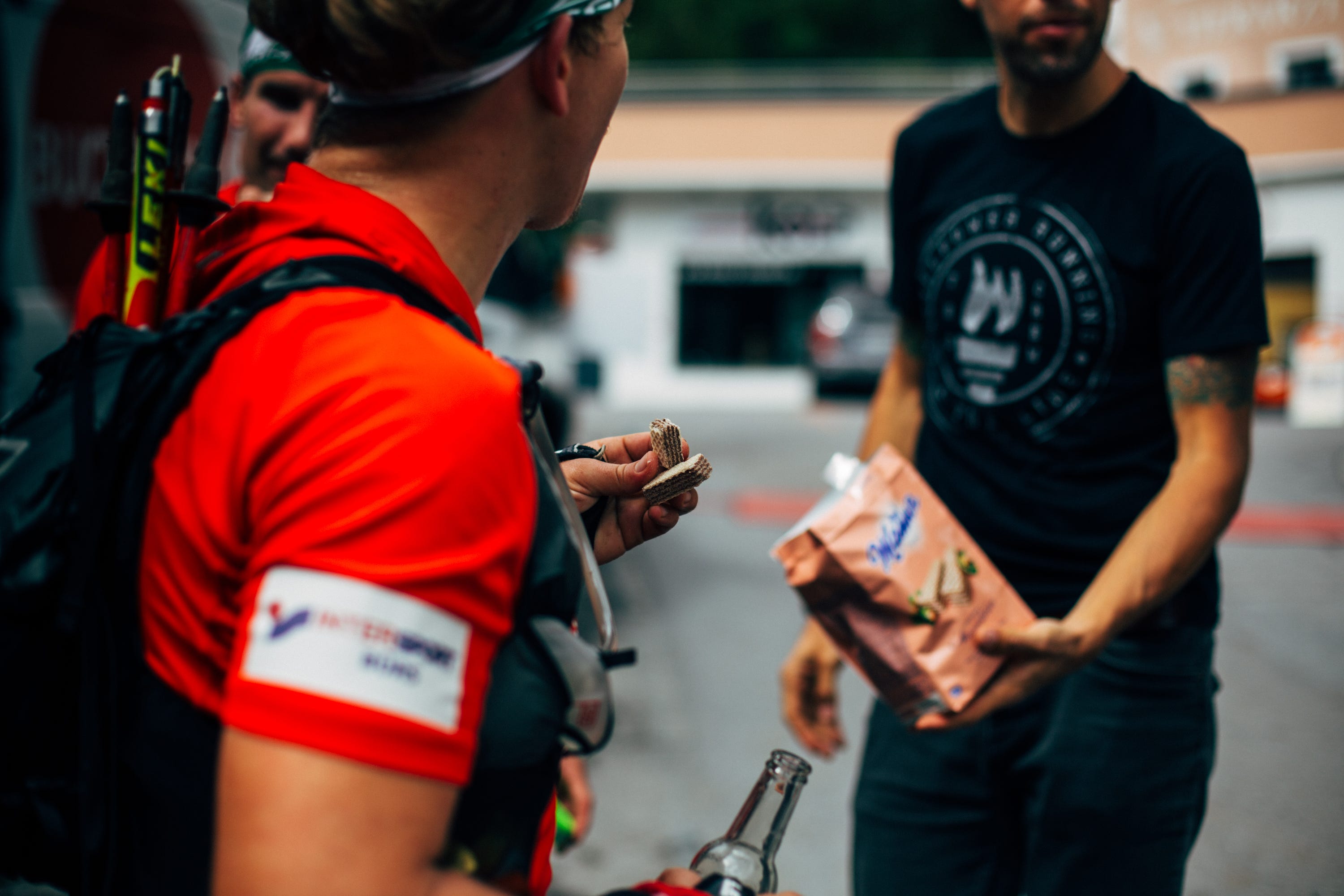
Suddenly we’re slurping down neon-colored gels that taste like a chemistry lab spill, chewing bars with the texture of plywood, and swallowing salt tablets that feel more like taking medicine than eating food. If the race is long enough we literally eat everything just to keep going. We wash it all down with half a bathtub of water and, at the finish line, proudly say:
“I fueled well.”
Hello contradiction.
The Bottomless Pit
Truth is: running is an energy black hole.
A body in motion burns through everything: carbs, salts, water, even itself. If you push it too far, at some point, the body starts breaking down its own muscle. It’s not common, but it happens. And it’s terrifying.1
That’s why, no matter how much peanut butter (mus not butter!) we eat at home, once the long run or track interval starts, sugar rules the kingdom. Cheap, fast, straight into the bloodstream. We, the clean-eating preachers, turns into glucose junkies.
The Gift and the Trap
Here’s the beauty, listen to this:
“Behold, as one runneth much, so must one eat much.”
(Unknown, maybe by me)
Runners get to eat. A lot. We earn our pizza. We deserve our midnight snacks. Food becomes a celebration and a necessity. Even if you're not a competitive athlete, you can easily burn half your basal metabolic rate by running regularly. Or more.
But that gift can be a trap, too. Because there’s always the off-season. Or injury. Or life stepping in and putting your shoes on the shelf. Appetite stays, mileage drops. And suddenly the equation flips: what used to fuel your running now weighs you down.
That’s when you realize that food isn't just fuel. It’s a relationship. And sometimes it’s complicated.
The Dark Calories
Content Note: If you're struggling with eating disorders, please skip this section and jump down to "A Note of Care" below for support resources.
This is where it gets ugly. Running can feed eating disorders. Not just for elites. Not just for pros. For us, the average joes and janes, too.
It often starts innocent: an app logging calories, a quick step on the scale after a race, the quiet thought: “If I were just two kilos lighter, I’d be faster.”
And suddenly every bite is math. Every gram is guilt. Every meal is a test you pass or fail.
The myth that lighter always means faster has been baked into running culture for decades. And yes, there’s some truth. Carry less, move quicker. Simple physics. But physics has limits.
Push past them and you pay: with injuries, exhaustion, hormone crashes, the loss of joy. Too often, you only realize it when it’s already broken.
I’ve heard too many stories of runners proud to toe the line on an empty stomach, convinced that hunger is part of the game, slowly starving themselves under the disguise of discipline. Or they simply neglected to adjust their diet to accommodate their increased running milage. Until their bodies could no longer cope.
Running should carry us, not consume us. And that's exactly why we need a clear approach: viewing food as part of running. Not as an enemy. Not as a controlling force. Rather, it should be seen as what it is: the foundation of every kilometer we run.
Where I Stand
I love food almost as much as I love running. Maybe more. For me that means eating vegan, as consciously as I can, not as dogma but as a way to support what my body demands. For you it may look different. Doesn’t matter. What matters is joy. And trust. And giving your body enough of what it needs.

Because, stripped of all the hype and marketing, it’s simple:
Eat enough. Don’t eat crap. Listen to your body.
Then lace up.
And keep running.
Hopefully forever.

A Note of Care
If you're struggling with your relationship with food, exercise, or body image, please know that you're not alone and that help is available. Eating disorders are serious but treatable conditions, and reaching out for support is a sign of strength.
Resources for Support:
Bundeszentrale für gesundheitliche Aufklärung (BZgA): Beratungstelefon Essstörungen 0221-892031 oder bzga-essstoerungen.de
Nummer gegen Kummer: www.nummergegenkummer.de - 116 111 (für Kinder und Jugendliche) oder 0800-111 0 550 (für Erwachsene)
Waage e.V.: waage-hh.de - Beratung und Therapie bei Essstörungen
NEDA Online Screening Tool: Take a confidential assessment at nedaassociation.org/screening-tool
Everything Not Running
Summer is really hitting hard here in Garmisch-Partenkirchen, and Lisa and I have found the best way to handle it: almost every day we wander down to the Loisach, the river that flows through this place, and dip into the cold water.
Sometimes we just splash around up to our knees, sometimes we go all the way under. It depends on our mood. And how brave we’re feeling.

What’s funny is how little we take photos now. In the past, we would have snapped a hundred pictures of afternoons like these, trying to capture every moment. But we don’t feel the need anymore. Why is that?
The river, the mountains, the quiet, none of it slips away. It’s just… part of life now.
Instead of chasing after moments to remember later, we get to simply live them. Every dip in the river, every ride home in wet sandals, every sunset that lingers over the valley, it all feels permanent.
We’re really happy here. Truly, deeply happy.
On Repeat
The list of hardcore subgenres is endless. What sounds like the same “noise” to most people can be distinguished by the discerning listener based on all kinds of details. And if there's no name for the subgenre, you just make one up.
In the 90s, we called the genre we're talking about today “sweatpants metal.” Simply because most bands that played this style performed in sweatpants (sometimes entire tracksuits). Things were simple simple back then.
What we e're talking about here, is the first wave of what is now commonly referred to as “metalcore.” When the first bands came up with the idea of fusing classic (death/thrash) metal and hardcore in the 90s, a multitude of different interpretations of this new genre emerged. In Europe in particular, a few bands with a strong Slayer influence made a name for themselves: Arkangel, Reprisal, and Sentence. This type of guitar riffing had never been heard in hardcore before and was a unique selling point.
The style remained largely a niche, but has now been picked up by a young Spanish band called Faced Out. From the songwriting to the cover design to the lyrics, everything is on point “sweatpants metal.” Here with the song “...a Fatal Sacrilege” from their album “At Eternity's Edge,” released today.
Hi Chris, das ist ein sehr wichtiges Thema, also das mit Essen und Laufen. Es war in einem der letzten Runners World auch Thema für einen Artikel von einem jungen Mann, der Essstörung entwickelt hatte und darüber ganz offen geschrieben hat.
Ich habe mich auch über das Bild mit Manner gefreut, da wir das auch manchmal essen! :-) Mit Gels habe ich in der letzten Zeit auch herumexperimentiert bei längeren Läufen , mit dem Ergebnis, dass ich jetzt lieber wieder Energieriegel mitnehme. :-) . Die Gels sind teilweise so klebrig, dass ich sie nicht runterkriege.