

In this article, I present numbers and data. These are my personal values. I don’t want to impress or disappoint anyone with them. You can read exactly what I mean in this wonderful disclaimer article:

A Year Going Up
This year I’ve already climbed more than 100.000 vertical meters. That’s four times more than I usually do in a year, and 2025 is not even over yet.
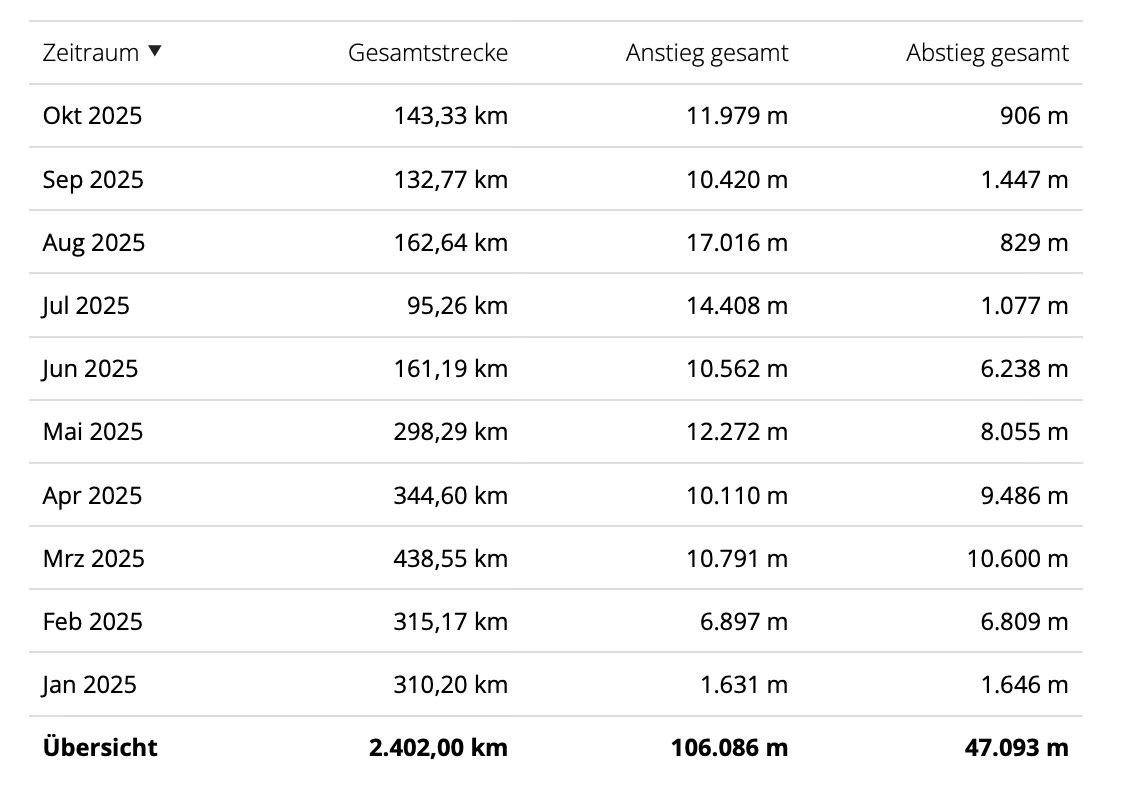
At first glance, this figure seems impressive. After closer inspection, however, these statistics are rather pathetic. The total number of kilometers run is lower than it has been in eight years, and my downhill elevation loss has decreased dramatically since May.
The explanation is straightforward:

Because of my knee injury, I cannot run downhill. I can run flat, but not far, and definitely not fast. And also rather not on asphalt. So I keep going up. It’s the only movement that feels carefree, the one thing my body and mind can still agree on.
Asymmetrical Athlete
By almost exclusively running uphill, I’ve become a strange kind of asymmetrical athlete — fit in one direction, useless in several others.
In running culture, we worship the idea of complete and balanced fitness — endurance, speed, strength, mobility, resilience, recovery, nutrition, mental strength — as if you could just collect all these attributes like trading cards.
But symmetry and completeness are illusions. Even the most balanced training plan produces imbalance somewhere. Too much strength, not enough speed, too much mind game, not enough rest. You always chase after what you are weakest at.
Truth is: complete symmetry might be the least natural state of all. What we call balance is usually just the brief moment before the next breakthrough. Or injury.
The Cult of Metrics
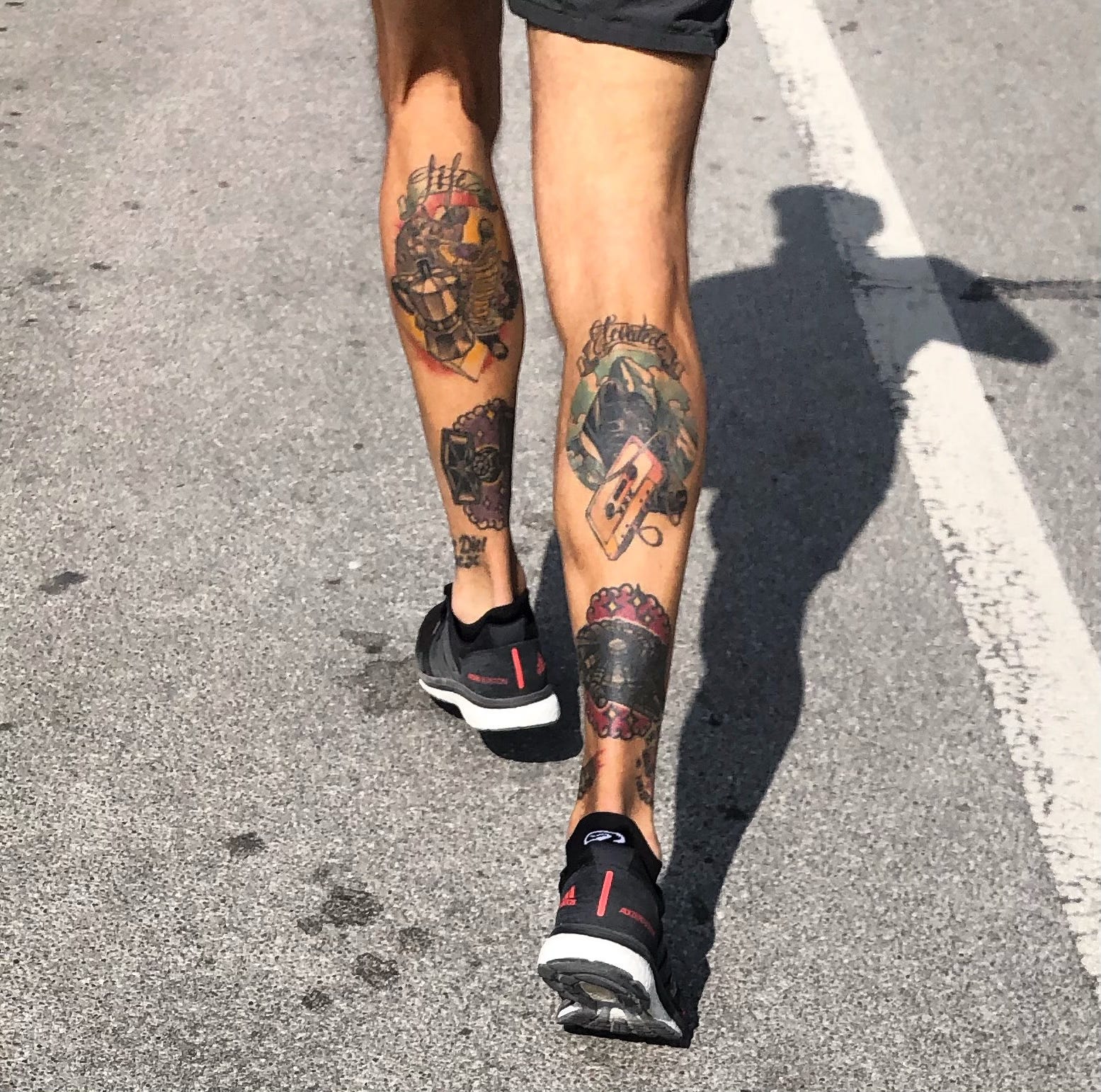
When I started out as a road runner, the world was much more one-dimensional. I was baptized by the holy spirit of marathon metrics. There were four specific ways to run. To train. Because running was always training. Although, if you didn’t run a hundred kilometers a week, you weren’t even training. Every run had a pace attached to it, and every pace could be translated into a marathon finish time, and that finish time was all that mattered.
That was stupid. But also simple, clear, and easy to understand and implement.
Unlearning the Road
Since I achieved the only marathon goal that was important to me (and within my reach) last year, I have left that world behind. Moving to Garmisch, at the foot of Germany’s highest mountain, was the last nail in that coffin.
The mountains don’t care about your marathon time. They don’t care about splits, cadence, heart rate, or how symmetrical your Strava charts look. They demand something else entirely: attention, humility, patience.
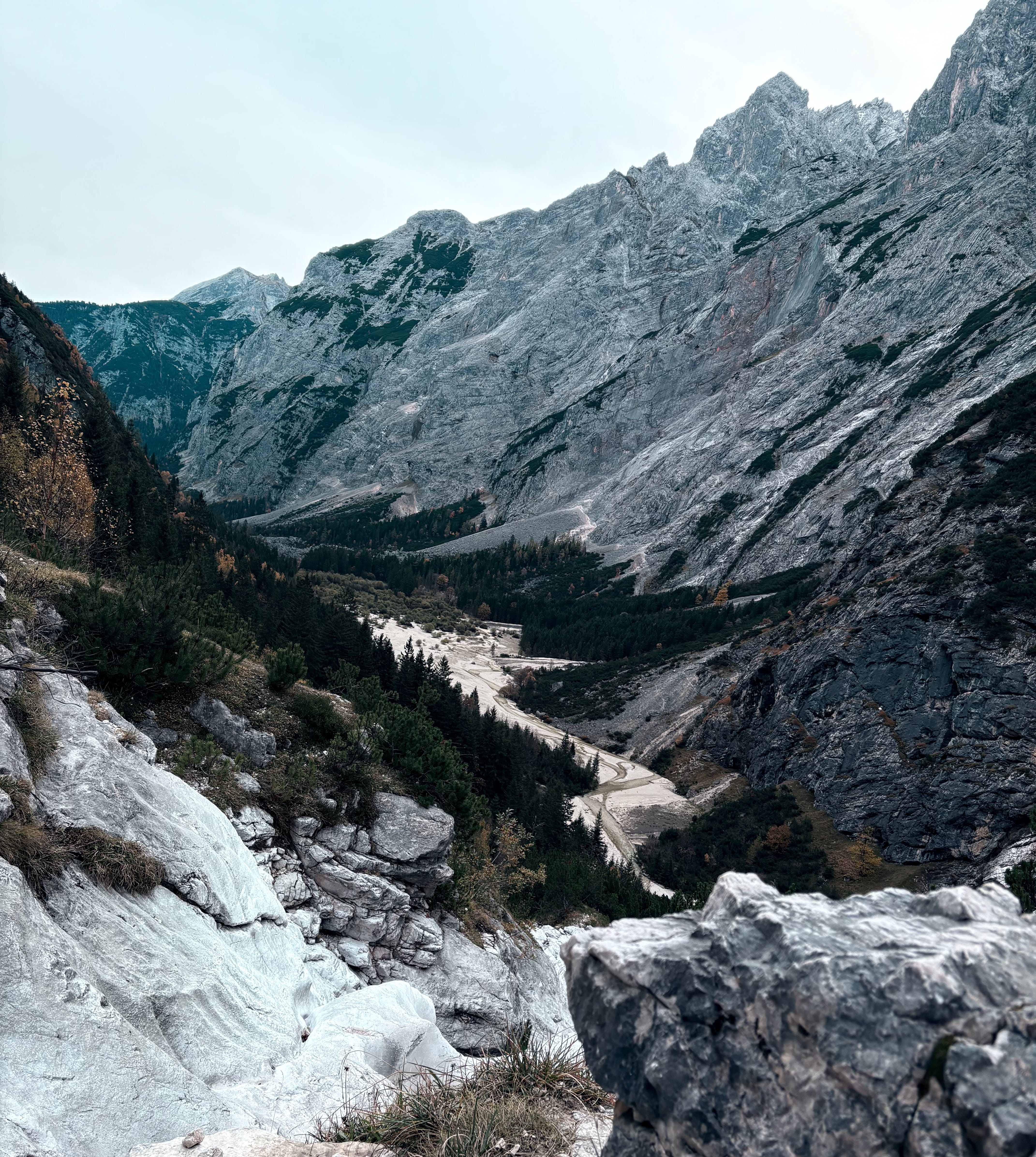
And although this world of emotional perception is less tangible and less measurable, I feel comfortable up here. I run freer than ever before. A every day, I am filled with gratitude and admiration for the tranquility and beauty of the Great Outside (in capital letters) here.
Still, I miss something.
Running downhill, for example. The speed, the flow, the small element of risk that makes it feel alive. Also the lights of the city that sparkle at me from the valley when the sun has disappeared behind the mountains.
I miss running flat, too — the monotony, the clockwork rhythm, the tap-tap-tap of shoes on asphalt, hart auf hart. And the impressive distance you can cover in a 3-hour run.
Oh, and I miss the red oval, the tartan track. The place of sacrifice for high heart rates and burning muscles. Where “one more rep” seems out of reach, but then becomes reality.
But none of this is possible right now. So I take what I get and do what I can. And that’s not so little.
Collecting Trophies I Don’t Want
A nice side effect of only running uphill: No matter which mountain I choose these days, I run up faster than ever before. Strava confirms it with its little trophies. Even on a casual Tuesday training run, I climb the mountain faster than I could the previous week.
On my Same Old Mountain, my valley-to-summit time has melted away week after week — twenty minutes faster than when I started running up there regularly. That’s satisfying. The data-driven Levelhead inside of me loves it. Yet, whenever I set a new personal best, I can’t help but wonder: What do I do with it now?
How does this translate into the next running season? Into races? Being able to run uphill fast might help in Verticals, but I can’t run verticals for a whole year. To compete again, I need to be a more complete athlete. Less asymmetrical. I need to run down as well as up. I need to run flat, long, and steady again.
Because the biggest season (and only) goal hasn’t changed: I want another Western States qualifier, and that means finishing a hundred-kilometer or hundred-mile race. Vertical meters don’t count, not even 100.000.
What It Means to Be a Runner
All of this makes me wonder what being a runner even means when the running part shrinks. My comforting doctrine – especially when being injured – is that running, at its core, is less about distance or pace and more about persistence. It’s about identifying as someone who moves, no matter in which direction. And even a runner without running is still a runner, the same way a musician without a stage is still a musician. The identity doesn’t disappear. It just humbles itself for a while.
Injuries have a way of doing that. Some days I’m hopeful. Confident that I’ll be back running in all directions freely soon. Other days I’m not. But that’s how it swings, the pendulum of injury. Healing isn’t linear, neither is running.
Meanwhile, I’m learning to appreciate this odd, asymmetrical version of fitness I’ve built. It’s one-sided, maybe, but it’s also proof that I didn’t stop.
The Cable Car Countdown
As the weeks pass by, there’s one practical issue with all this vertical living: I’m dependent on cable cars to get back down and in three weeks, all of them in my hometown Garmisch-Partenkirchen will close for maintenance before the winter season. Some will reopen when the snow comes, but running up mountains in winter is another story.
Maybe it’s time to finally embrace winter sports, but I’m not sure. I’m still too afraid of getting injured again. Well, actually, I’m still injured. And besides, I’m a runner. Currently an uphill runner, but still a runner.
A Strange Kind of Hope
So I keep climbing while I can. My fitness might be asymmetrical, narrow, and incomplete, but it’s mine, and I’m proud of it. It’s a reminder that adaptation is still progress. I’ll take what I have — this odd, vertical strength — and keep moving upward.
Everything Not Running
Watching what has become of the United States of A hurts more than any injury ever could. As someone who once studied and admired this country — its culture, its contradictions, its courage to reinvent itself — I now look at it and barely recognize what I loved.
The tone has changed dramatically. The manners have vanished. Where there once was disagreement with respect, there is now contempt without consequence. Public life has been stripped of all decency. There’s a climate of fear and hate in the streets. Those in power act shamelessly and self-servingly, treating truth and facts as something optional, negotiable, disposable.
I don’t blame one person alone. I blame an entire administration, a whole formerly respected party, that turned into yes-men, cowards, and opportunists who praise loyalty over integrity. And those who, from the shadows, set the course and write the rules. Straight toward autocracy. Or fascism if we’re being honest. Either word will do. And all of this is happening right before our very eyes.
I try not to look at the headlines all the time, but they find me anyway: the racism, the sexism, the ignorance, the small-minded greed masquerading as policy. It’s embarrassing to watch and it leaves a taste of exhaustion and disbelief. A daily mixture of stress, anger, and sadness that’s hard to run off.
Even if a new administration one day manages to end this nightmare, the damage is done. Trust is not something you can rebuild by decree. It takes generations.
Maybe the America I respected — the contradictory but ultimately humane America — will return. Maybe not. But for now, my heart aches.
On Repeat
Alongside Tony Sly (RIP) and Greg Graffin, Joey Cape arguably has the gentlest and most beautiful voice in punk. Listening to him feels soothing and immediately transports you into the world of the thoughts and feelings expressed in each song.
Fortunately, in addition to his main band, Lag Wagon, Joey Cape has also recorded several solo albums. His solo work brings you even closer to his great stories and relatable emotions.
However, the song that moves me the most is actually a Lag Wagon cover: “Wind in Your Sail.” Even in 100 years, this song will captivate me as deeply as it does today.
The video is part of the “Kaputtmacher Sessions,” a wonderful YouTube series that invites artists who usually play harder music to perform acoustically. Of course, Joey Cape does this with ease.
Hi Chris
Das Ungleichgewicht ist wahrscheinlich immer da, mal laufen wir nur Ebenen, eine andere Zeit - so wie Du- Berge hoch und runter- mal nur hoch und nicht runter und mal - durch Krankheit verursacht- eben gar nicht. Ich war letztes Jahr auch traurig, weil ich - nach Nierenstein OPs - eine Zeitlang nicht laufen durfte, obwohl die Beine konnten. Alles fließt, nichts bleibt beständig. Und je älter man wird, desto mehr andere Leiden kommen dann eventuell dazu, mal zwickt es hier mal da. Trotz alledem bleibt man/frau/divers dran, bis es eben gar nicht mehr geht, bzw. läuft.
Was die USA angeht, ja das ist wirklich traurig und erschreckend und ich habe auch die Befürchtung, dass das nach hier überschwappt, wenn man sich das hier alles anschaut, ist es ja teilweise auch schon so. :-( .