

Naming It
I’m done downplaying it: I am injured.
Yes, I can run. Yes, I can line up at races. But when my knee flares up after every single workout, and that irritation lingers for months without leaving, then it’s not just a “niggle.” It’s an injury.
The First Whisper
You know the story already. It started in May. A faint irritation in my right knee. Barely noticeable, but unusual. Normally, post-run aches calm down after a night of rest. This one didn’t. It lingered, quietly, almost politely.
And then came May and June: four races in quick succession, capped by the ultimate A-race, the Zugspitz Ultratrail (ZUT). With each one, the irritation carved itself deeper. What could have been a small warning turned into a constant presence. During the big training weeks prior to ZUT, it was clear: this wasn’t going away on its own.
After the Peak, the Pause
The ZUT was my main race in 2025. I had promised myself that once it was done, I would give the knee the break it deserved. And I did. I even went further: I declared the off-season. No structured training, no pressure, just rest.
But weeks of rest didn’t erase the problem. The knee stayed unsettled. The Levelhead didn’t just want to wait, so I committed to a full “Return to Sport” rehab program with my physiotherapist. Carefully built-up strength, mobility and load, step by step, everything by the book.
Still, the irritation remained.
What the Images Revealed
That’s when I agreed to the MRI. I had delayed it for months, knowing how overwhelming and discouraging these images can be. They always show a laundry list of imperfections, but rarely one simple cause.
The results? A knee with many voices speaking at once:
Good news first: The torn meniscus has healed perfectly. It looks like new (Except that there is a large gap, of course)
A patellar tendon, inflamed and slightly torn (the main suspect)
A bone marrow edema under the kneecap (kinda serious one, slow to calm, demanding patience)
A Baker’s cyst, already once burst last year (now making a return appearance)
An irritated Hoffa’s fat pad (whatever that is)
And cartilage damage, second degree.
That last one didn’t shock me anymore. It’s been there, unchanged, in every MRI I’ve done over the years. I’ve learned there’s a third and a fourth degree of damage, far worse, far more final. In that strange way, this minor detail of my diagnosis felt almost like relief.
A Family of Conflicting Needs
Here lies the challenge: all these battered structures want different things. One needs rest. Another thrives under tension. A third demands constant motion. It’s like trying to make three kids happy when one wants ice cream, the other a roller coaster, and the third to camp in the forest.
What’s the solution? Movement — carefully chosen. Uphill running works best, flat is tolerable, downhill is forbidden. Cycling is fine until I push too hard. In the gym: heavy isometric holds, always mindful not to overload the kneecap. Stability, posterior chain, pelvis. All on repeat. Add a dose of shockwave therapy, maybe PRP1 down the road.
And above all: patience. Endless patience.
Not Alone in This
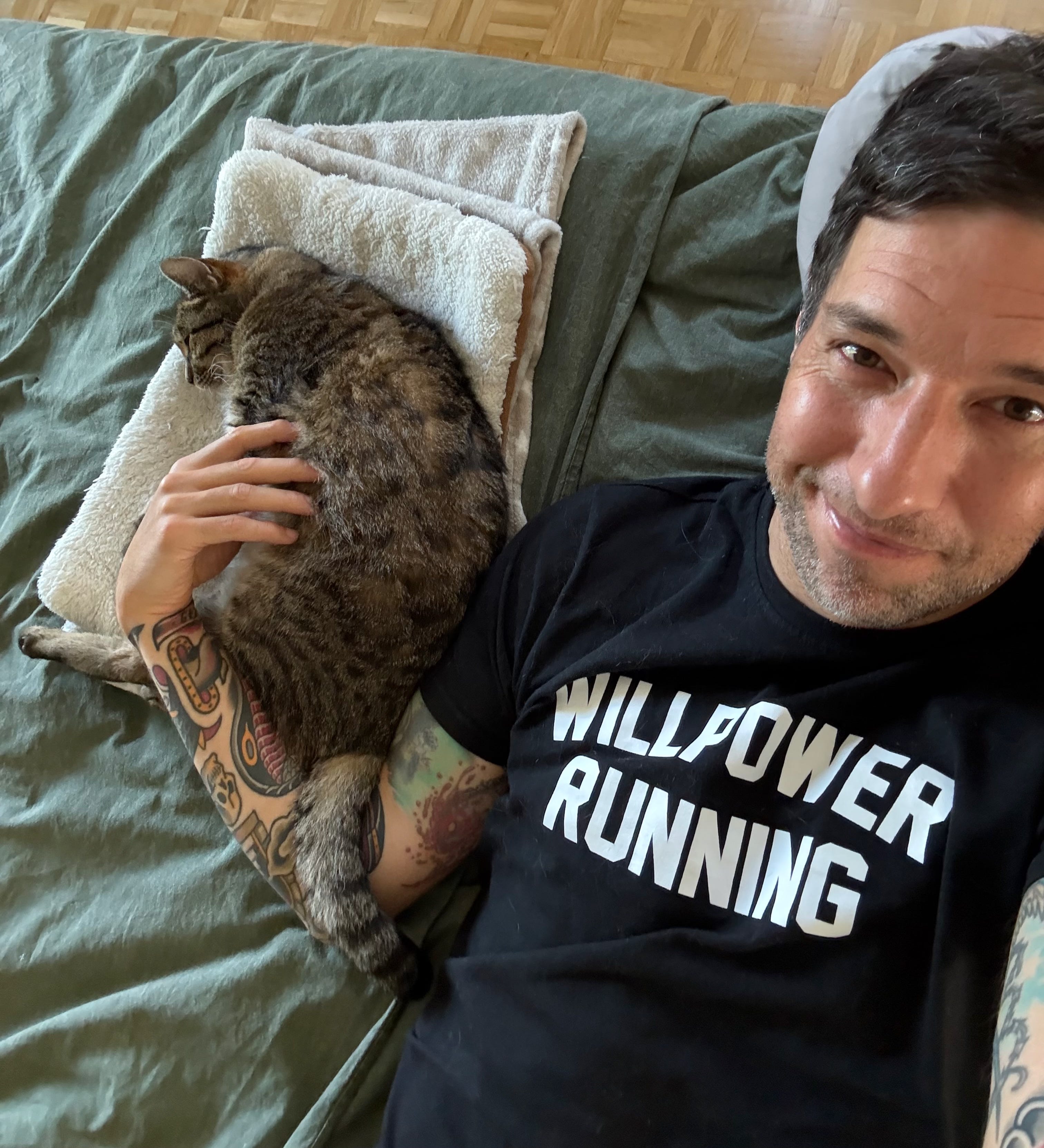
The good news is: I’m not facing this in isolation. I have a physiotherapist, an orthopedist, my coach, and other sports scientists. They know me, they know what this means to me. They understand that running isn’t just a nice hobby but a central part of my life. And they’re helping me protect it.
That doesn’t make the truth easier to say. But it makes the path forward clearer.
A Season of Highs
Before all this, the year had felt like a surge forward. The kind of season you dream of, stringing achievement after achievement together.
A surprisingly fast comeback from meniscus surgery. Possibly a bit too fast.
Finishing the ZUT against tough conditions, earning my Western States qualifier
My fastest trail half-marathon ever at the GaPa Trail.
The fastest 1000m intervals I’ve ever run on the track.
Five races in two months. Three more than mattered.
I wanted to believe all of this was simply who I had become: stronger, faster, untouchable. But the truth is simpler, harsher: I was running beyond my means. Over my body’s capacity. Pretending I could cash checks it couldn’t cover.

Why It’s Hard to Say
So why, with all this evidence, was it so difficult for me to say it plainly: I am injured?
Because the irritation was and is mild. Because I could and can still run, still race, still look like everything is fine.
And because I didn’t want to be that runner “who’s injured again” — the one who’s fragile, the one who breaks.
I wanted to believe I was stronger than ever. That all those results came without cost. Admitting the injury means admitting the illusion.
Why Saying It Matters
So here it is, again, and without caveats: I am injured.
Not “a little irritated.” Not “just managing.” Injured. And that truth doesn’t make me weak. It makes me honest.
What Truly Remains
Running is a gift, not a guarantee. Every time the body lets us move the way we want, it’s worth more than we usually realize.
The body will resist. It will break rhythm. It will demand patience. That is not failure. That is life itself.
And in accepting that truth, in speaking it out loud, there is a strange, quiet strength.
I am injured. And that’s okay.
Everything Not Running
Off on vacation! Well, 30% vacation, anyway. Next week, the main task will be to support our friend Juliane in an epic running adventure: the Tor des Géants in the Aosta Valley of Italy. It's a 330-kilometer non-stop ultra-trail race with around 25,000 meters of elevation gain — no one knows the exact figure. It's a colossal race. To stand at the starting line of the Tor, one must have impressive physical fitness, an extremely resilient mental state, great courage, and a little bit of madness. Juliane has it all.
However, the Tor is a team sport. Without a crew, completing such a race is nearly impossible. I experienced this firsthand when I supported my wife, Lisa, in the 2021 Tor des Géants. It was the hardest support job I have ever done. For her, it was the hardest race ever. It was also the most emotional adventure for both of us.

Lisa and I are well-prepared for the task. We have pooled all of our experience as runner and supporter, and we are very confident that we will get Juliane through the race.
With a little luck, it will also be a 30% vacation. We'll travel in a camper van (thanks, Alles-Laufbar.de!), drink liters of Italian espresso, and occasionally go for a run in the mountains ourselves. All of this will take place in one of the most beautiful mountain regions in Europe.
In any case, we are excited. I will report back.
On Repeat
Punk's not dead. It never will be. One of the newer punk bands I'm pumped about is Get Dead. To me, they're the new Rancid. Musically, they're not that different from the punk legends, either.
Get Dead blends melodic punk rock with gritty acoustic sounds, raw vocals, and a mix of folk and hardcore influences.
Politically, they take a clear leftist, anti-authoritarian stance and are often critical of the state, police brutality, and capitalist structures.
The song "Disruption" sums up everything that Get Dead stands for. Anyone with even the slightest interest in punk rock will get teary-eyed listening to it.
Platelet-rich plasma (PRP) therapy is a treatment that uses a patient’s own concentrated platelets to promote healing and tissue regeneration.
Heal up and try to savor the quiet. Also, ask your docs what they think about backward walking. I'm not one for "miracle cures," but since I began every run with 5 minutes of it about a year ago, my (undiagnosed) knee weirdness has disappeared. I came across an older gal in Hawaii doing the same, stopped and asked her why she was doing it, and she said, "It has reversed my knee pain." At the very least, it's low-risk to try.
how long did your meniscus take to heal? I know that everyone is different (runners and menisci ..) but I'd just like to know. I have that myself right now, on a knee with a bit of a injury history (for example I had ACL in 2012 ... and I live and run without that ligament since then).
best wishes, patience and trust ...