
Dressed to Hurt
How running fashion hides and reveals who we really are

Some start lines look less like races and more like a slightly chaotic runway.
On one side: full-kit believers in tech fabrics, laser-cut ventilation (or holes allegedly made by moths), shorts that cost as much as a weekend trip.
On the other: a sixty-year-old in blown-out split shorts, a cotton race tee from a 1984 half marathon in Tallahassee, and sunglasses that should probably live in a museum.
Somewhere in between stands the all-black runner who looks like they’re heading straight to a hardcore show or anti-nazi demonstration after the finish.
That’s me & my friends.
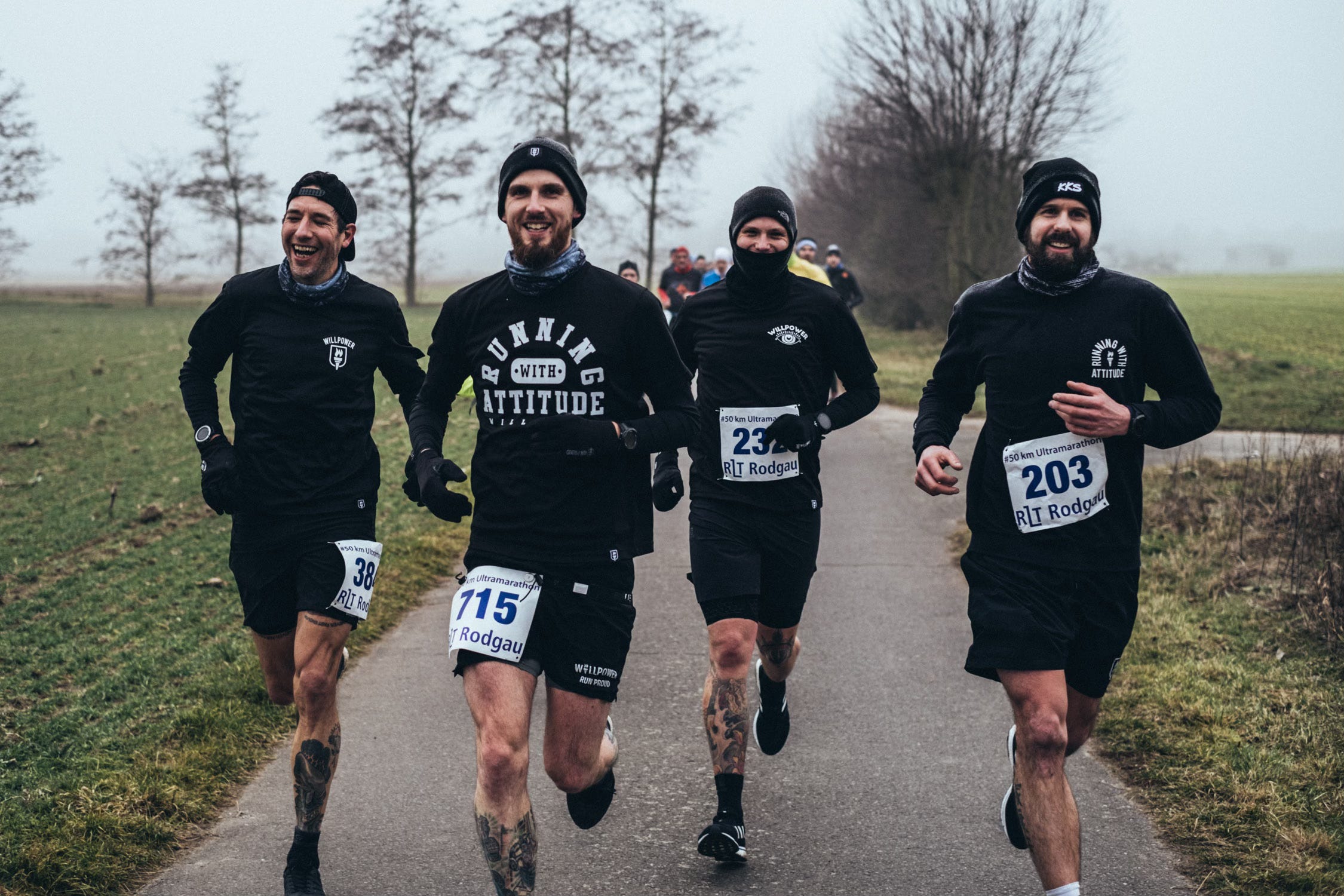
The funny thing? Almost everyone on that line is quietly convinced they’re the one who looks cool.
When running became fashion
For a long time, running gear was basically fluorescent plastic: practical, reflective, anonymous. High-vis yellow, generic logos, fabrics that felt like they were designed by road safety engineers, not people who actually loved this sport. One of the reasons I started my running brand Willpower ten years ago was because I couldn’t stand that faceless neon polyester universe anymore. I wanted shirts that felt closer to 90s band merch than to emergency vests.
Fast-forward and running hasn’t just become “stylish”, it has become fashion. Real fashion.
Capsule collections. Collabs. Catwalk shows. Limited drops you have to “cop” in sixty seconds. Seamless base layers that look like they belong in a gallery. Silk scarves. Oakleys that make you look like an insect. Shorts with a backstory and a waitlist. Tights made for a runway instead of a hill repeat.
The pendulum didn’t just swing away from neon. It flew right through it and crashed into a different kind of costume.
Which is ironic, because Willpower was supposed to be the counter-statement to that first wave of faceless gear… and somehow ended up a counter-statement to the second wave as well. Either I’ve done a lot right, or I’ve been out of sync with what’s cool for a decade straight. Both might be true.
The constant, though, is this: in the end, everyone thinks their costume is the hottest one. Even though we all know that once the race starts, nothing about us will stay curated for long.
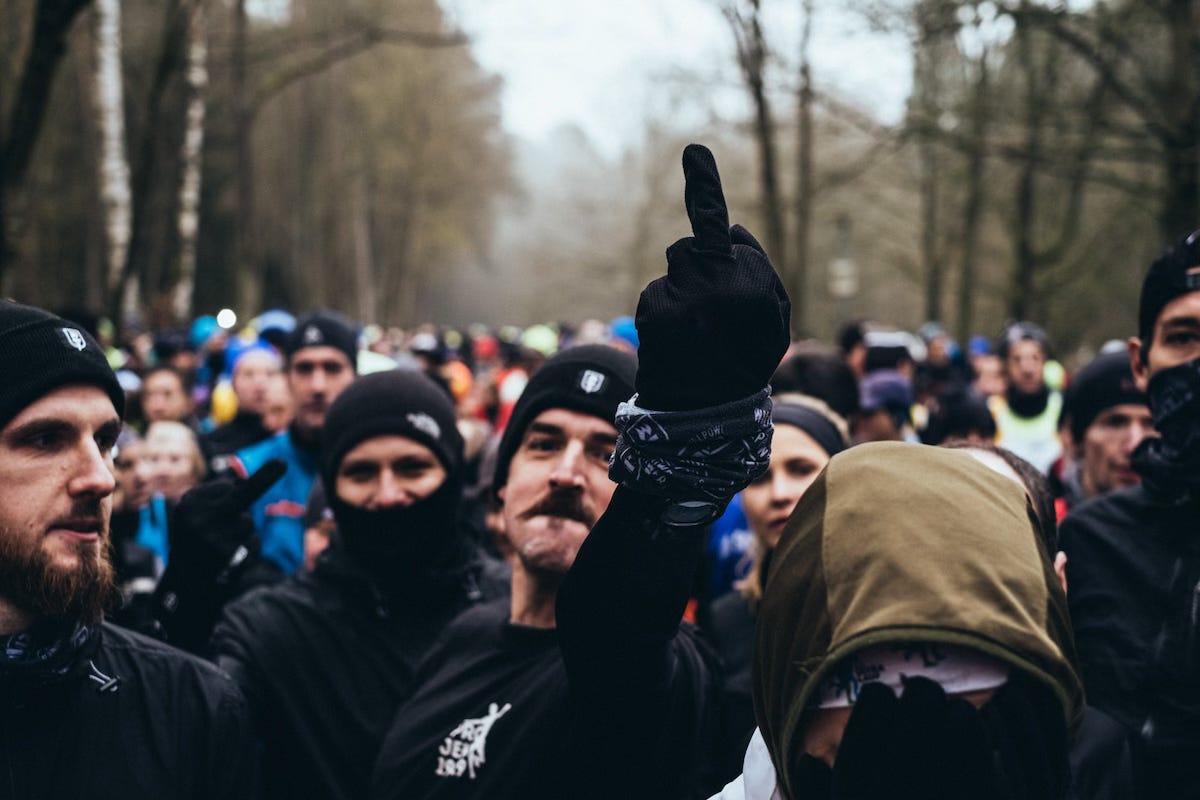
What our costumes are really doing
If everything can fall apart that quickly anyway, why do we put so much effort into what we wear?
Because clothes are the first sentence of the story we tell about ourselves as runners.
“I mean it.”
“I don’t care.”
“I know things.”
“I’m old school.”
“I’m new school.”
“I’m not like those runners, I’m like these runners.”
Even if you never say it out loud, your kit says it for you.
The Levelhead inside you (if there is one) might point out that good fabrics actually matter: no chafing, no freezing, fewer things to worry about when the race gets hard.
The Punk in you (if there is one) might resent the price tag and the performance theatre and still show up in a shirt that used to be black before a thousand washes.
Both are real. Both are human. Both are trying, in their own way, to make sense of where they fit.
When costumes falls apart
The equalizer shows up the second the gun goes off.
Fashion is about controlling your image. Running is about losing control of it in the most honest way you can bear.
Ten minutes into a race, nobody looks curated anymore. Faces go red. Strides get shaky. Sunglasses fog. The expensive singlet starts sticking to your chest like a mop. Safety pins on your bib deform your shirt. Salt stains appear in places no campaign shoot has ever shown.
The race does not care what you’re wearing. It only cares what you can hold.
No bonus seconds for your sunglasses.
No PR for your color coordination.
No applause for your perfectly fitting tights.
It’s not that clothes are meaningless. It’s that their meaning collapses as soon as effort takes over. Once your watch starts beeping, the main story begins. And that story is the only one that counts.
Radically undressed
Running, especially racing, is quietly radical in a way fashion can’t touch.
The road, the trail, the track… they don’t care who dressed you. They don’t care if your socks were a free gift in a start bag, or bought at a secret popup store. They don’t care if your singlet was custom screen-printed in a tiny studio or pulled from a second-hand bargain bin.
They care whether you show up.
They care whether you stay.
They care who you are when it hurts.
The start line is the one place where the banker and the barista, the kid in the €200 kit and the uncle in the cotton tee, all get the same distance, the same course, the same chance to be cracked open by effort.
You can’t buy your way out of what the second half of a race does to you. You can’t accessorize yourself away from the quiet panic of realizing you went out too fast. There is no brand that can save you from the conversation with yourself when a DNF suddenly sounds reasonable.
What your kit might be hiding
Still, gear is not neutral. It’s never just “what was clean” or whatever happened to be “on top of the pile of clothes”.
Maybe your kit is a shield: If I look like I belong, nobody will notice how scared I am.
Maybe it’s an excuse: If this goes badly, I can blame the shoes.
Maybe it’s defiance: I’ll wear this torn old shirt because I refuse to play along with whatever this scene has turned into.
Maybe it’s hope: New shoes, new shorts, new me. This time it will work.
Sometimes it’s all of those at once.
None of that is wrong. But it’s worth noticing. Because on some level, running fashion can trick us into thinking we’ve changed something essential, when all we really swapped was a color, a logo, a silhouette.
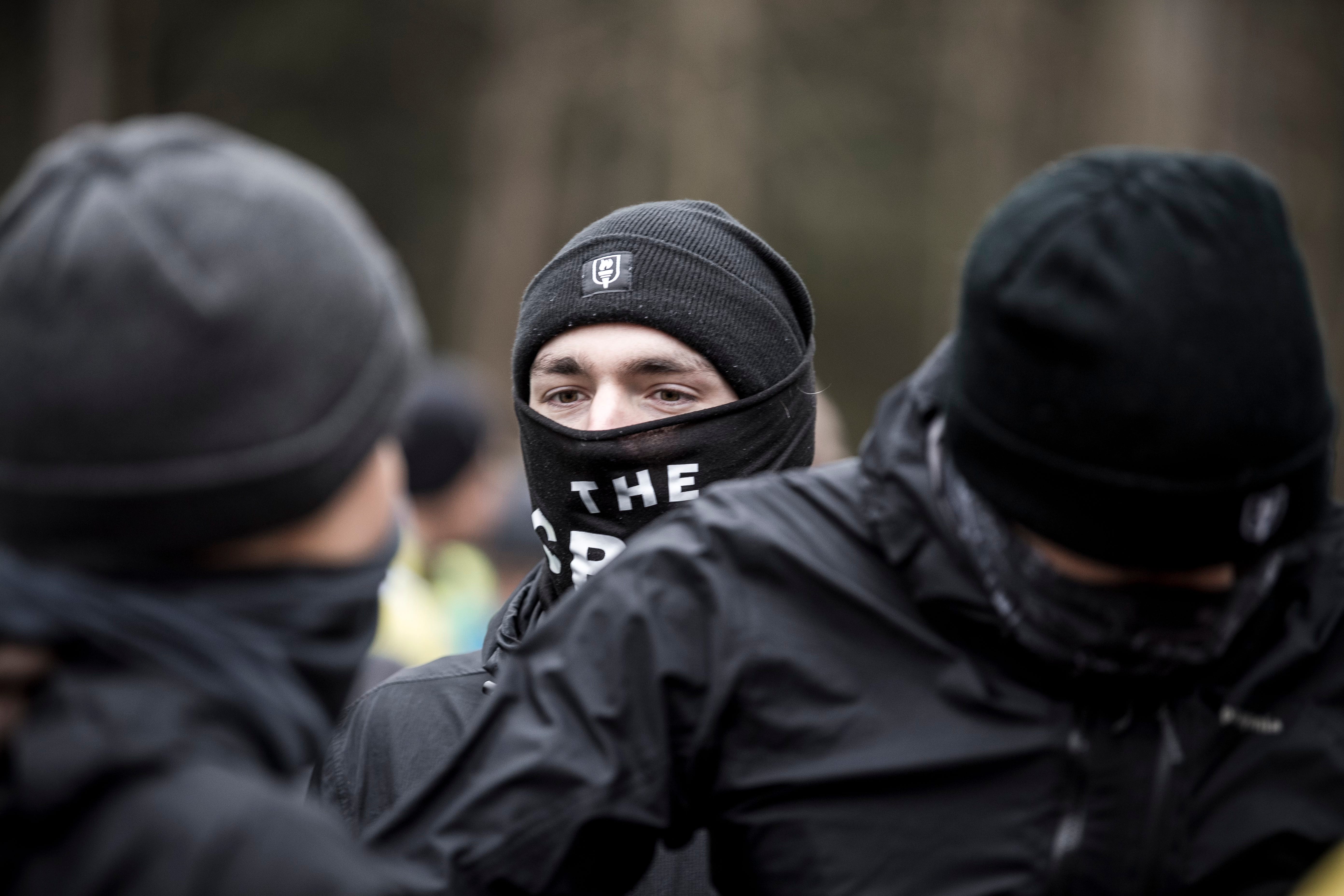
Dressing up for the same lesson
If you zoom out, the whole thing looks almost tenderly absurd: Dozens, hundreds, thousands of us, obsessing over fabrics and cuts and colorways, all lining up to be humbled by the same three things:
Distance.
Time.
Our own minds.
We arrive wearing different costumes, chasing different aesthetics, trying to broadcast slightly different messages. And still, every race quietly asks the same question:
When all outer shells fall away — what’s left?
The way you carry yourself when the split is slower than you wanted.
The way you react when someone passes you at the end.
The way you talk to yourself when things don’t go to plan.
The way you treat the runner who suffers more visibly than you do.
The way you speak about the race afterwards when the photos are posted and the likes roll in or don’t.
That is your real outfit. The one you can’t change in the porta-potty ten minutes before the start.
So, what’s running fashion, really?
Maybe it’s not a particular style, brand, era, or cut. Maybe running fashion is simply the visible layer of how we want to be seen in a space that, sooner or later, will show who we actually are.
You can show up as the Tech Kit Hero, the Vintage Purist, the Voluntary Fashion Victim, the All-Black Hardcore Kid, the Minimalist Who Claims Not To Care. The ground beneath your feet will listen politely and then ask you to prove it, or drop it, or rethink it.
So the next time you lay out your race outfit on the floor, maybe add one more question next to the socks and the gels:
What story am I trying to tell about myself? And who am I when that story falls apart?
Everything Not Running
I had a cold. Again. For the third time this winter. I don’t know if it’s because I’m only doing a fraction of my previous training volume, or if it’s related to age (I just turned 47), but it’s incredibly annoying. Everyone talks about consistency and sticking with it and so on. That’s difficult when you’re knocked out of action every few weeks by a completely unnecessary cold.
But never mind, that’s water under the bridge now. I’m fit again and back to my rehab routine of strength training, stairmaster sessions, run-walks, and long walks. A little bit more every week. I have no idea if this will lead to the desired goal, but in any case, it’s what my knee allows me to do without complaining too much.
On Repeat
Alright, so Hardcore 2026 is now fully completed. I believe that there is nothing else to come this year.
My first marathon was Berlin in 2008. It was the first time I’d run in another country and I enjoyed trying to work out where people might be from based on their kit. It was also the first time I’d seen the “Swiss-Triathlete” look of skin tight everything
I had to laugh and nod at the same time. I've always said that when I started running, you could identify the 'real' runners as they were the biggest dags (geeks/dorks/nerds) around. The new breed of runners is definitely very different, kitted out in the latest gear.
That said, when I lived in Italy recently, in spite of the Italian penchant for fashion, I found the Italian runners to be less about style and more about function (and being good athletes).